
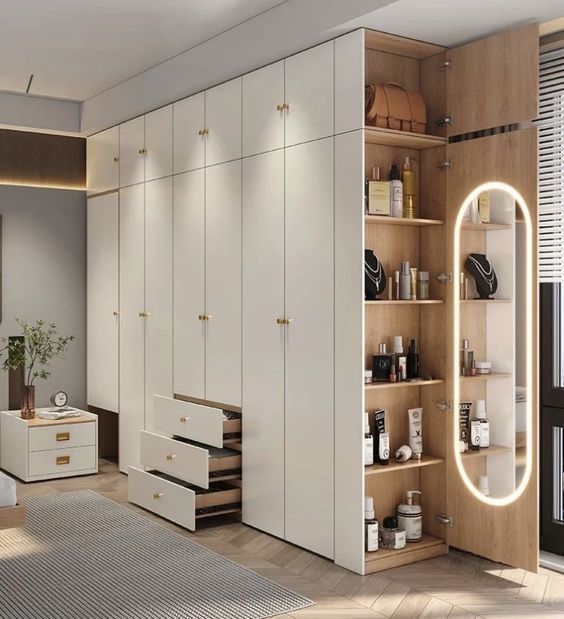
Aesthetics and storage are closely related in contemporary house interior design. The wardrobe design with dressing table is one of the most popular and successful pairings that have become popular in bedrooms and dressing areas. In addition to being useful, this integrated setup gives every area a hint of refinement. Such a setup enables homeowners to optimize space, preserve organization, and improve their daily routines by fusing practicality with aesthetic appeal.
In addition to offering plenty of space for storing clothes and accessories, a closet with a dressing table attached acts as a specific area for personal care and grooming. For urban homes where every square inch matters and space efficiency is crucial, this hybrid furniture piece is perfect. Its advantages extend beyond space savings, though. An regular bedroom may be transformed into an opulent suite that represents personal comfort and flair with the correct design.
1. Being aware of the function and goal
The fundamental concept behind including a dressing table in a wardrobe is practical space management. A built-in dressing table within or next to the wardrobe provides a clever and practical solution in homes without separate dressing rooms or walk-in closets. It simplifies the daily grooming routine, gets rid of clutter, and does away with the need for more furniture.
In terms of functionality, the dressing table usually has a mirror, drawers for personal grooming products and makeup, ambient lighting, and maybe even a stool or seat. When combined with a thoughtfully planned closet, the entire space transforms into a little gathering place for clothing and personal hygiene.
2. Urban Home Space Optimization
Due to space constraints in modern urban residences, multipurpose furniture is not only desirable but often essential. Residents can reduce floor space and still have the comfort of a dressing area by combining a closet with a dressing table. Designers can guarantee smooth integration and close the gap between the two functionalities by creating a unified unit.
Innovative design can improve efficiency without sacrificing style, as seen by walk-through wardrobes with central vanities, sliding wardrobes with a foldable mirror, and corner wardrobes with an angled dressing table.
3. Material Choice: Juxtaposing Sturdiness and Style
The longevity and overall appeal of wardrobe-dressing table combos are greatly influenced by the materials chosen. Common options include solid wood, MDF, plywood, and engineered wood. Although manufactured alternatives like MDF or particle board are more affordable and adaptable for contemporary finishes, solid wood still provides a high-end appearance and long-lasting sturdiness.
The room’s tone is also established by the exterior paints, veneers, or laminates. Depending on the homeowner’s preferences, high-gloss acrylics, matte laminates, textured wood grains, and glossy finishes can all be used to produce a striking or understated look.
4. Fashions That Fit All Styles
When it comes to dressing table and wardrobe designs, there is no one-size-fits-all solution. Styles range from opulent classic to minimalist modern to accommodate various interior designs. Ornate mirrors, carved wood details, and brass fittings are examples of a vintage-inspired design, while clean lines, neutral hues, and concealed knobs are examples of a contemporary style.
Even more variety can be found in dressing cabinets with a bohemian rattan frame or mirrored closets with built-in vanity mirrors. Customization is essential, and selecting a design that complements the room’s concept improves harmony and practicality.
5. Lighting: The Hero Without a Name
Lighting is a feature that is sometimes disregarded when incorporating a dressing table into a wardrobe. Both usability and visual appeal can be significantly enhanced by proper illumination. The precise completion of grooming activities is ensured by LED strip lights, backlit mirrors, or spotlights above the dressing unit.
Glamor is also added by lighting, particularly when warm tones are employed to draw attention to accessories and finishes. The experience can be further enhanced and given a tech-savvy touch with motion sensor lighting within drawers or wardrobes.
6. Mirrors: Not Only Reflections
A dressing table isn’t complete without a mirror. Mirrors are used in wardrobe designs as a decorative and spatially enhancing element in addition to being a grooming tool. Large vertical mirrors can give the impression that a room is larger and brighter than it actually is.
Consider backlit mirrors for a contemporary twist, framed mirrors for a traditional appearance, or frameless mirrors for a sleek appearance. Some even have sophisticated features like built-in touch controls for lighting and anti-fogging.
7. Configurations for Storage and Internal Design
The main purpose of a wardrobe is to provide orderly storage. The inside arrangement needs to be carefully considered when a dressing table is included. Internal wardrobe plans should incorporate shelves, drawers, hanging space, and accessory compartments.
There should be drawers on the dressing table for jewelry, skincare products, cosmetics, and grooming equipment. Pull-out trays and modular drawer organizers can improve functionality even more. Open shelves above the dressing table can be utilized to showcase decorative things or store hairbrushes and perfumes.
8. Personalization & Touches
Each person has different requirements, and a wardrobe-dressing table that is specially made enables specific touches that improve the user experience. Customization gives countless options, ranging from picking handles, knobs, and mirror styles to deciding on drawer depths based on product sizes.
While some people might choose a simple dressing table with a mirror and a few drawers, others could prefer a more ornate arrangement that includes side cabinets, lights, and even stools. Customized design guarantees optimal usefulness without going overboard.
9. Family and Couples Wardrobe Designs
Differentiated zones and dual-access storage must be taken into account when designing for shared areas. Morning traffic can be avoided by equipping a couple’s closet with two dressing tables or mirror panels on either end.
Labeled divisions and drawer separators keep things organized for several users. Wardrobes with kid-accessible drawers and locked valuables compartments provide further utility in family settings.
10. Integration with Other Furniture and Beds
Wardrobe-dressing table units frequently match other pieces of furniture, such as beds, side tables, and chairs, in harmonious interior design schemes. All components of a modular bedroom set with coordinated finishes are guaranteed to blend in perfectly.
To make access more easier, some designers include the dressing table into the headboard or at the bed’s side. These integrations improve the overall atmosphere of the bedroom and show astute design thought.
11. Hinged vs. Sliding Doors: Which Is Better?
The wardrobe’s usefulness can be greatly impacted by the decision between sliding and hinged doors. Because they don’t require any clearance to open, sliding doors are perfect for small spaces. They only allow access to one side of the closet at a time, though.
Although they provide complete access, hinged doors need room to open. More imaginative dressing table arrangements are made possible by hinged doors, which also allow mirrors to be mounted inside or outside. In the end, the decision is based on personal preference, space size, and arrangement.
12. Corner Units and Effective Use of Space
For inconvenient or unused locations, corner wardrobes with dressing tables attached are a clever option. They frequently have L-shaped designs that make the most of corners without sacrificing usability.
When attempting to make the most of every square inch of available space or in smaller spaces, these ideas are extremely helpful. In order to provide a complete and small configuration, the corner unit can additionally have overhead storage and vertical lighting.
13. Dressing units with smart, modern features
Even dressing tables have changed since the introduction of smart home technologies. Contemporary dressing units can incorporate technologically advanced elements that improve convenience, like as USB charging ports and voice-activated lighting.
Touch-sensitive mirrors, temperature-controlled drawers (for skincare products), digital time displays, and built-in Bluetooth speakers add luxury and enjoyment to the grooming ritual.
14. Small Room Dressing Tables
It may not be possible to have a separate dressing table in small bedrooms. In these situations, the wardrobe can incorporate vertical vanity modules, pull-out drawers, and folding mirrors. Another space-saving choice is a sliding dressing table that slides into the closet when not in use.
These layouts are ideal for guest rooms or studio apartments where little space needs to be used for several purposes.
15. Comfort and Style in Dressing Table Seating
A dressing table’s seating is frequently an underappreciated feature. The experience of using the dressing room is improved with comfortable seating, whether it be an ottoman, built-in bench, or padded stool. Upholstery can be coordinated with the décor of the space, and some stools have built-in storage for added functionality.
In bigger arrangements, a personal grooming lounge can be created by placing an armchair or recliner adjacent to the dressing table.
16. Cleaning and Maintenance Advice
Regular cleaning and maintenance are necessary to preserve the wardrobe-dressing table units’ operation and look. Make sure drawers and hinges are kept in good operating order, dust the surfaces every day, and refrain from applying harsh chemicals on mirrors or finishes.
Organize drawers once a month, get rid of things that have gone bad, and keep water from leaking near electrical parts like charging docks or mirror lights.
17. Cost considerations and budgeting
The materials, level of design complexity, size, and personalization all affect how much a wardrobe with dressing table costs. While premium designs with fine wood, finishes, and clever features might be much more expensive, basic modular units may start at a reasonable price.
Quality within your price range is guaranteed when you plan your budget in advance and collaborate with a respectable furniture brand or interior designer.
18. Final Thoughts: Combining Form and Function
More than just a piece of furniture, a well-designed closet with a dressing table makes a statement about personal taste, style, and usefulness. This integrated design provides an attractive solution that meets both storage and grooming demands, whether you’re remodeling your bedroom or outfitting a new home.
Every element contributes to the creation of a harmonious space, from the choice of materials to the lighting and mirror types. A stylish, functional, and aesthetically pleasing wardrobe-dressing table unit that improves your everyday life can fit into even the smallest spaces with careful design.